Life without Anorexia

My motto is
'Dont let the sadness of your past & the fear of your future ruin the happiness of your present'

My life at the moment is completely different to how it once was. I spent 5 years sick with anorexia nervosia and depression as well as struggling with self harm and overexercising. I spent 2 years in different treatment centres.
And since 2012 i have been declared healthy from my eating disorder.

I have been blogging for 7 years, and my whole journey is written in my posts. I now represent healthy and happiness. I want to show anyone struggling that it is possible to recover, no matter how hard it may seem.

I now blog about recovery, my life, veganism and positivity!

If you have any questions leave them in the comment section as i am much quicker at answering there, otherwise you can always send an email: [email protected]

Translate

Showing posts with label orthorexia. Show all posts

Monday, April 6, 2015

Exercise addiction answer (Masterpost)

I find this exercise thing so tough. I am nearly at a normal BMI and have exercised the whole way through my recovery. But you could argue I went from controlling my food to controlling my exercise - I am in the gym for X hours or so a day but I was eating enough to gain weight.

It is important that you get help for your exercise obsession and that you begin to decrease exercise. Doing X hours exercise a day is 1) overdoing it 2) unnecessary and 3) will lead to consequences and you will eventually burn out. You cant live a life if exercise is your only focus and you are obsessed with doing it. I suggest that you begin to cut down to 2 hours a day, then from there you decrease to 1hr55 then 1hr50 and make sure to take a rest day a week. Find other hobbies and things to distract you. 

The reason you have been gaining weight is most probably is most probably because your body is so stressed and your metabolism is very slow from over exercising and not eating enough, so instead of losing weight like normal people would your body holds onto the weight and shuts down certain functions to save energy and is constantly holding onto weight as your body doesnt feel safe.


So try resting, think is this really how you want to live your life in 5 years time? To still be stuck in these routines and fears? To not be able to fully live life, or have energy to live life? To not be able to travel or just lie in bed a whole day or go on a roadtrip or other things where you have no control and no control over exercise.

Ask yourself what is the worst thing that could happen by not exercising? What will happen if you go a whole day without exercise? What will happen if you go 3 days without exercise? What will happen if you do a one hour workout instead of a 3hour workout?

Trying to meet with friends or family, be social, is a good way to fight your exercise addiction because then you are forced to sit down and do other things.
  
When you are fighting off your exercise addiction i know it can feel tough, that your thoughts are going crazy, you feel extremely restless and can almost feel like ants are creeping under your skin due to the anxiety. But you have to stay still and relax. It is alot easier when you are with others becuase when you are on your own it's far easier to just start exercising. But find something you can do instead. Find a comfortable position and stay there... challenge yourself to sit for 20 minutes in a row, then 30 minutes, then 40 minutes. Then challenge yourself to sit and watch a whole 90 -120 minute film. Also challenge yourself to rest before, during and after meals.

It is a challenge, but i can promise you. To not have an exercise addiction, to be able to live life and do exercise because you enjoy it is truly amazing and wonderful. To feel and love the endorphines from working out and to be filled with energy after a workout and to still have time and energy to socialize and do everything else in my life. To not care if i have to miss a workout or if i am sick and lie in bed a whole week. That's life and you can't just keep pushing your body if it doesn't want to or to priortize exercise over everything else in life. Because do you really want to look back on your life and think... 'Great i exercised several hours everyday...  i have no other good memories because i was always tired and had no one to socialize with and all the exercise just broke my muscles and bones down and didnt stop my skin from sagging or becoming wrinkley or stop me from dying...'

So how would you rather live life? Enjoying every moment or stuck in habits and routines?

Below are lots of links to helpful posts:

Saturday, March 28, 2015

Orthorexia

The last 2 years have shown a visible increase in literature on the topic of orthorexia nervosa, despite not actually being in the DSM-5. Does this lack of “true” diagnosis make this condition just another buzz word, or is this the start of a new breed of eating disorders? Furthermore, is the lack of diagnostic criteria ignoring a whole new subset of those with disordered eating under the guise of “health”?
Definitions and Diagnostic Criteria
Orthorexia literally means “proper appetite”, a misleading name given the ramifications of those cited with orthorexia. It was first described in 1997 by Bratman and Knight after Bratman described his own experiences with orthorexia. The symptoms vary from focusing purely on “clean” or “healthy” food to feelings of deep guilt when going “off plan” or eating something “not clean.” Compensatory behaviors that are often found with those who suffer from anorexia nervosa or bulimia are very similar. Orthorexics will exercise compulsively to “make up” for their “mistakes.” They also obsess over nutrition labels and will start to isolate themselves from social events surrounding food for fear of going off their diet. These criteria all shadow behaviors of other eating disorders as well as obsessive compulsive behavior.
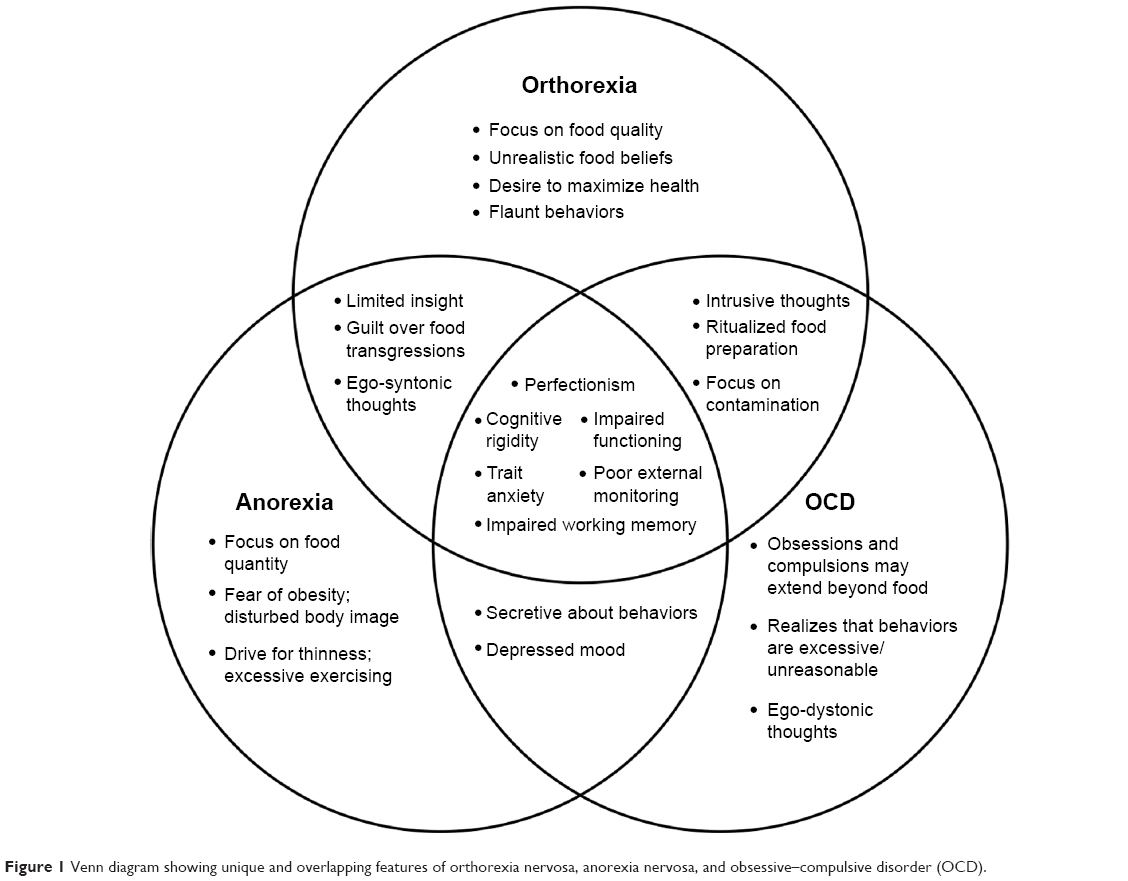
From “The clinical basis of orthorexia”, a venn diagram showing the overlapping criteria of orthorexia, anorexia and OCD
Orthorexia’s onset can be more insidious than this extreme behavior, though. Often someone starts off wanting to “eat healthier.” They decide to remove a food group from their diet, then another, then another. Before too long they have a very strict set of rules around what they can and cannot eat. These rules and structure make them feel safe and in control, and as long as they abide by them they are eating “healthy”.
One very, very important distinction is that this group has no medical, religious or ethical reason to avoid certain food groups. While those suffering from orthorexia will often claim they are allergic or intolerant to dairy, gluten, etc. they often have never been formally diagnosed. Most of those who suffer from orthorexia have self-diagnosed allergies and intolerances to food groups. Those who do actually suffer from allergies and are intolerant to certain food groups may still fall into other categories of disordered eating, however for the sake of this discussion we will not include them.
One major departure from orthorexia and anorexia (according to research) is the motivation behind the disorder, though I personally disagree. Anorexia’s end motivation may be about weight loss, but there is never “skinny enough” for those with anorexia. They often are unable to see how sick they truly are. I would argue that anorexia is ultimately about control, and here it doesn’t depart too sharply from orthorexia. The suggested criteria for orthorexia points to a need for those to feel “pure” or “clean” by controlling what goes into their body. This mirrors the controlling aspect of anorexia. However, those with orthorexia are quick to flaunt their behaviors, while anorexics are very secretive about theirs. More on this can be read in the paper included at the end of this article.
The Dark Consequences of Orthorexia
Some might argue that orthorexia is a word used by those who “don’t get it” to describe the passionate. Without an official diagnostic criteria this might be true, however it’s impossible to ignore the consequences of unchecked orthorexia. Unchecked orthorexia can mirror a lot of the consequences of anorexia. For example, omitting entire food groups can lead to deficiencies in certain micro and macronutrient groups. Side effects include anemia, osteopenia, bradycardia, hyponatremia, and others.
Other consequences involve the effect it can have on your social life. Food anxiety makes any social outing involving food almost impossible for those with orthorexia. Given the serious overlap between orthorexia and anorexia they’re prone to the same binge-restrict cycles as those with anorexia. Deviations from their diet are met with self loathing and guilt. They spend an inordinate amount of time researching, planning and excluding foods from their diet.
Causes
Since this condition is not officially diagnosed, nor is there outstanding data involving its manifestations and treatment, it’s hard to pin point the specific causes of orthorexia. However, there are some places we can look to understand the obsession around health and purity.
  • Fake trainers or nutritionists: Every celebrity is endorsing some diet these days with very little understanding of the consequences of their support. It’s not hard to find a book, website, or blog touting a certain type of diet or food exclusion as THE way to lose weight or become healthy. In fact, there are entire companies built on the insecurity of the average person, creating groups and “coaches” out of everyday, unqualified people. While some of these people may mean well, they ultimately are unqualified to give advice about diets. This creates and endless cycle of misinformation, usually involving statements like “I saw celebrity name gave up gluten, so I did, and now I feel amazing!” or “I recently started pyramid scheme diet here, and I lost 20 lbs!” While these statements may be innocent in the beginning, they can quickly lead to feelings of guilt when strayed from. Since they focus on excluding food groups they may eventually lead to the same social anxiety described by many with orthorexia.
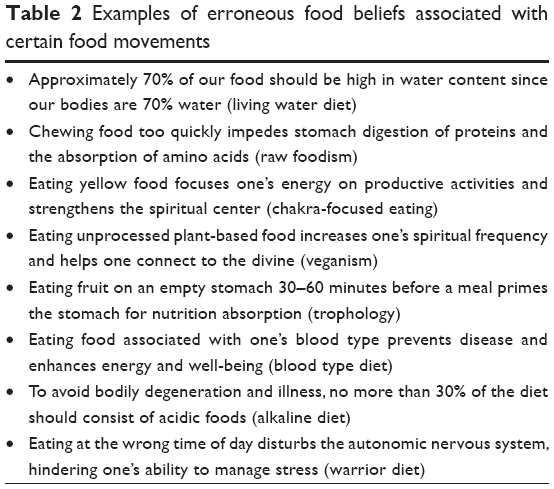
Examples of misinformation found in popular diets, all which have been discredited but are still touted by popular diets. Source: The clinical basis of orthorexia.
  • Weight loss/health as a social status: We are often to praise people for losing weight or being healthy without truly understanding what it meant to that individual. “Healthy” and “fit” are a social status that are openly praised. Someone who updates social media with their workout or posts about not indulging in the bagels at work are seen as “strong” and someone to look up to. Diets are often associated with strength and willpower to the point where those who don’t adhere to diets 100% are seen as “weak” and “lack willpower.”
  • Good Food/Bad Food Dichotomy: The minute certain food groups are seen as “bad” or “unhealthy” a dichotomy is created. Labeling food as “good” or “bad” without any true understanding of what it means to an individuals diet or health is unrealistic and unhealthy.Research has shown time and time again that if you tell someone they can’t have a certain food type they will crave it. This can contribute to the food binges experienced by orthorexics when they eat one thing off their “meal plan.”
  • Fad Diets: Researchers have noted that orthorexia patterns of food aversion parallel whichever fad diet is currently circulating.
Where To Go From Here
I have stated many times that this condition lacks an official diagnostic criteria, and is not currently recognized by the DSM-5. However, theNational Association for Eating Disorders has been compiling data on the topic and has a page devoted to education on orthorexia. This topic has also been explored by a number of popular websites around health and fitness. While it is not currently an eating disorder it IS a type of disordered eating. It is something that interferes with daily life and disallows enjoyment of life. If you feel that you’ve spent an inordinate amount of time worrying about food, or you feel like you might have orthorexia, it is important to seek the health of a trained professional. Disordered eating can lead to eating disorders, and the associated complications from dietary restrictions are severe enough to warrant intervention in some cases.
If you’d like to learn more about the current research of orthorexia, The clinical basis of orthorexia: emerging perspectives is a great paper to help inform you about orthorexia

Source: X

Thursday, October 23, 2014

Why you shouldnt exercise while in recovery

All text below is taken from HERE

ON-EXERCISE ACTIVITY THERMOGENESIS (NEAT)

Do you prefer to stand when doing things that most people do while sitting? Do you try to avoid sitting? Do you fidget? Do others comment that you always seem to be on the go? If you answer “yes” to any of these questions, then these behaviors are non-exercise activity issues within the context of a restrictive eating disorder.
I am usually told in no uncertain terms by many with restrictive eating disorders that they are not exercising to try to limit any weight gain. They assure me, and everyone else, that it has nothing to do with body image or food intake at all. They are merely exercising because they love it; it makes them feel strong and healthy; and it improves their mood.
Studies unfortunately suggest that you are desperately trying to believe your own advertising when you swear that the exercise you do is all good.
In another study, best predictors for identifying exercisers who also had an eating disorder were if they agreed with the following statements:
  • being annoyed if exercise interrupted
  • others feel you exercise a lot
  • feeling bad if unable to exercise a certain amount
  • feeling that you have/had problems with exercise.
 [C Boyd et al., 2006]
Ironically, high levels of depression were more likely with both AN and BN patients who exercised excessively, and levels of anxiety and somatization were particularly high but only with excessively exercising anorexics [E Peñas-Liedó et al., 2002]. The irony of those data is that exercise for non-eating disordered patients tends to ease depression and not exacerbate it.
A community-based study in Australia had the following outcome:
“Exercising to improve appearance or body tone, and feelings of guilt following the postponement of exercise, were the exercise variables most strongly associated with elevated levels of eating disorder psychopathology and, in turn, reduced quality of life.”
[JM Mond et al., 2004]
Yet another comparative evaluation of how eating disordered patients engage in exercise when compared to healthy controls:
“The anorexic group were significantly more hyperactive, exercised more frequently and engaged in a wider variety of exercise behaviours. They were also more likely to exercise in secret and were more compulsive about exercising. They displayed a ‘negative addiction’ to exercise, and gave control of their negative mood states as their major reason for undertaking it.”
[CG Long et al., 1993]
You may find the Exercise for Restriction Quiz worth revisiting. I will address a bit later on in this post the ways in which you can help yourself stop being an apologist for exertion and start becoming an advocate for your own health and recovery.

Those with restrictive eating disorders are most likely to die of either cardiac complication or suicide [M Misra et al., 2004; AH Crisp et al., 1994].
Exertion (exercise and/or moderate to intense activity) both during an active period of restriction and during the recovery effort, are dangerous and possibly life threatening. Also keep in mind that active restriction does include cycles of restriction/reactive eating, bulimia, orthorexia and not just anorexia.
The heart’s ability to function normally is hit hard on three fronts with restrictive behaviors: physical damage to the muscle, electrolytic imbalances and de-myelination of the nerves.

You can also feel fairly confident that if it has crossed your mind that you are somehow not sick enough to need to rest and restore energy in your body then you already know that you are indeed “sick enough”. The term “sick enough” is only a concept that pops up for those with restrictive eating disorders.

UPPING THE INTAKE DOESN’T WORK

Many ask me if they cannot just increase their food intake to somehow make up the difference of the expenditure associated with their exercise.
Our bodies do not work mechanistically. A better analogy is that a body has adaptive and quite sophisticated triage rules. Triage is a system used in emergency environments to try to maximize the number of survivors. The body also tries to maximize its ability to survive by prioritizing biological functions in times of energy depletion and deficit.
If an energy deficit exists in the body thanks to a period of restrictive eating or under eating relative to excessive energy expenditure, then replenishing the energy of daily exertion on top of the basal metabolic requirements (which are suppressed*) will take precedence over replenishing the overall energy deficit throughout all the cells in your body.
*Metabolic rate is suppressed when the body does not have enough energy (food) coming in to support all the biological functions in your body. The metabolism is not broken and is in fact performing its life-saving ability until such time as you are energy balanced when you reach remission.
Basically your body is saying to itself: “Well if she’s going to drag me out for a run every morning then there’s no way I’m going to be trying to figure out how to reverse bone mineral density loss, or repair the heart muscle and I’ll keep the biological functions suppressed so that there’s enough energy to handle the godforsaken run along with staying alive until tomorrow.”
I have mentioned in other posts how glucocorticoids (cortisol) impact how your body uses the energy you take in. Stress varies both the levels and pulse rates of glucocorticoids such that your body will preferentially move energy into storage while continuing to suppress biological functions. Exertion and activity are huge stressors for an energy-depleted body.
Even if you could eat enough to truly support regular exercise, on top of the energy needed to stay alive and the energy needed to restore weight and repair damage, the body is stressed by the exertion to the point where you are going to tread water and fail to reach a full remission.


REPLACE AND DISTRACT

Stopping exercise sessions with nothing but yourself and your thoughts to keep you company will inevitably make you want to crawl out of your skin in short order. Researchers in the exercise dependence field recommend replacing the exertion with other non-exertion-based activities and distracting yourself from the times in the day when you are likely to want to indulge in exertion-based activities [K Linder, M Blaydon, 2007].
The first thing I always suggest as a great replacement is sleep. That would of course be second in line to the best of all replacements: food! If you happen to be an early morning exerciser, then simply sleep in.
For some, the usual morning wakeup is needed and provides some grounding. In that case, still set the alarm, but do 30 minutes of slow yoga stretching, or mindfulness exercises, breathing exercises, or just sitting quietly in the kitchen with a nice mug of something hot (and ideally full of calories too).
Distraction can help alleviate the negative mood, irritability and anxiety that you feel because you are not exercising. Have family breakfasts. Set up a mid-morning get together with a friend for a coffee and a muffin. Have a strategy for busyness at the times when you are most likely to want to exercise.
Enroll in activities (non-exertion) that you may have had some interest in in the past. Crafts, languages, learning new software packages: flip through what's on offer at a local community center to get inspired.
Getting out in the nature is mentally valuable. In fact there is now a whole sub-section of study on green activity. There are three kinds of green activities: appreciative, consumptive and motorized. Not surprisingly appreciative green activities improve environmental behaviors [MA Tarrant, GT Green, 1999].
Access to a garden or a green area a short distance from home is associated with less stress [TS Nielsen, B Hansen, 2007]. All green spaces improve mood, with the greatest self-esteem improvements realized for those who are mentally ill. Water in the green space generated greater positive effects in both self-esteem and improved mood, and mood improved within 5 minutes of being outside [J Barton, J Pretty, 2010].

How slowly can you go around the block? Make that your task. See if you can get it to 15-20 minutes for one block. Take in absolutely everything in your surroundings. Note every change. Bring a camera and take a picture of the same view each day so you can then compare after your walk whether you actually missed a detail from one day to the next or not.


^^I think whats written above (even if its alot) is great advice. However from the whole article the perception which i get from the author is that exercising is bad and not something you should return to after having an eating disorder. Which i think is wrong... According to the author (what i presume anyway) is that she would tell me i began exercising too early and that the only reason i like exercising is because i have had a past ED and using my 'i have had an active lifestyle while growing up' as an excuse to why i like exercising?
  Which is just wrong... I have learnt from my mistakes when it comes to exercise. I have over exercised and burnt out... but now i know better. Now i can listen to my body.
And i am definitely not someone to tell you that you cant exercise after having an eating disorder because thats not true. Of course you can... but you also need to find balance and not just exercise to compensate, to change your body or to burn calories. But to have a healthy reason. To enjoy exercising.... and if those cases are true and you are a healthy weight. Then go for it... enjoy exercise :) 
The problem with exercise is when it becomes an obsession and addiction... which usually only the person who is struggling can know.
^^^But read above why you SHOULDNT exercise while in recovery and trying to gain weight... even if you are suffering from bulimia or binge eating. Then too mcuh exercise isnt good for you either. It stresses the body too much.
Tuesday, October 7, 2014

Is exercise taking over your life?

Do you feel compelled to do exercise - even if you dont want to/too tired/dont have time?
Do you get anxiety/feel angry/frustrated if you have to skip a workout?
Do you secretly exercise even though you shouldnt/are too tired?
Do you get anxiety if you rest/spend a day at home and do nothing?
Do you feel like your workouts have to X minutes long to count as a proper workout?
Have you felt the need to keep increasing your workout length and intensity?
Do you feel anxious/guilty/irritated if your workout didnt go as planned/you didnt have enough energy to complete your workout?
Is your day ruined if you have a so called "Bad workout"?
Do you exercise even if you are injured?
Do you keep exercising even if you feel dizzy/faint/too tired?
Do your prioritize exercise over everything else?
Do you skip going out with friends/travelling/going somewhere else just because you might not be able to workout?
Do you skip going out with friends/eating out with others/eating with others because then you might have to eat food you dont want to eat or you feel anxious about the hours spent sitting?
You only have energy for your workouts, but after that you have little energy.


If 3 or more apply to you (or really... if any of these apply to you) then your relationship with exercise is NOT healthy. Taking a break from exercise, fighting the demons in your head.

Its ok to love exercise, its ok to exercise often. But its NOT ok to feel anxious for not working out, to feel that a bad workout has ruined your day or you feel that your obsession with exercise is keeping you back from doing things you want to do.

Exercise addiction is a serious problem and its something you need to get a control over before it can cause you any permanent damage/injuries.


If you feel that you are addicted to exercise/have an unhealthy relationship with exercise then read these 2 articles below.

PART 1
PART 2

Sunday, July 6, 2014

Orthorexic or just healthy?

Awesome post! I'm kind of curious though how you would distinguish between someone who has orthorexia and someone who is just being healthy. It feels to me like there's a really fine line. Like for instance if someone who went from being overweight to a healthy weight has to avoid all carbs and certain foods to keep at that weight then no one would question it. I mean their eating habits are praised because they no longer have the health risks of being overweight and also due to physiological reasons like hormones or a slower metabolism, they may have trouble keeping the weight off unless they have a very strict diet whereas if someone who is already at a normal or below average weight has the exact same healthy diet, they would be considered orthorexic or anorexic. I just feel like the defining point is sort of a blur as there is really nothing distinguishing two such people other than their physiology- hormones, metabolism, build, etc. Who is to say one is healthy and one is not?

There is a VERY fine line between someone who has an eating disorder (orthorexia) or just eating healthy. Thats why im not sure if orthorexia is an official diagnosis? Though i think it is now... but its also one of those things where many dismiss it as an eating disoder because, the person is just being healthy.
  I mean, who can complain if someone is exercising everyday and avoiding sugar and eating healthy? There is nothing wrong with that, or?


Lets begin with... if someone is overweight and losing weight, they might try some diets or have to cut down on carbs, sugar, processed and junk food. Bring lunch boxes with them and change their diet completely... and that doesnt make them sick. Not necessarily anyway...
  However if someone already slim or a normal weight starts doing that, it becomes a different story.... just because someone is slim and cuts down on sugary or processed food. It doesnt make them sick.
  Just like if someone is exercisign everyday, it doesnt make them sick either...

Really, its only the person themselves who knows whether they have an eating disorder or not. Whether they exercise to get rid of guilt for eating, or compensate for food. Whether they dont eat certain food because its a fear food, or because they dont like it.
   It feels like more and more people are saying they are gluten and lactose intolerant just because.... to avoid carbs or things such as ice cream or chocolate.
  I mean im slightly lactose intolerant, but i still eat quark, yoghurt and ice cream... though it has helped my stomach that ive cut down. But im not going to stop eating it, just because everyone else seems to have developed intolerances! haha


There are certain things though which you can see in someone who is sick compared to someone who maybe is a bit more cautious of what they eat and exercise more than 'average'.
  And some of those signs are spending an extreme amount of time on exercise... only talking about exercise. ALWAYS saying no to food that is offered. Not going out with friends so much. Only ordered water/diet cola (not even that as some see it as unclean), or constantly using the excuse they already ate or arent hungry.
  Not letting others cook for them, watching when someone is cooking for them. ALWAYS bringing their own food. Never eating say candy with friends/popcorn at the cinema/ice cream in the sun etc (I mean you dont havet o do this all the time... there are times maybe you dont want an ice cream, but to NEVER eat one or use the excuse you arent hungry, or ill just take water or ill just an apple isnt always a healthy sign).
   If you refuse to change your routine/travel/go anywhere else as you wont be able to exercise....
If someone gets moody/angry because they missed a workout or dont have time to exercise.

^¨Just some signs in someone who is struggling with orthorexia, or another ED.

 
But like i said, there is a very fine line. Because, No... maybe you dont want to eat cake sometime when you're out... i mean there are days when im with friends 4 days in a row and maybe i dont feel like eating chocolate the 3rd day, then maybe ill just take something else. That doesnt make you sick. But if everytime there is a social event or an event where food is involved and the person either has thier food with them or wont eat, its not such a good sign.
   If you are living healthy and exercising because you enjoy it, then you can also treat yourself, eat out... eat things which you might not eat everyday. Thats OK.
  But it feels like many  - im talking on Instagram now - seem to be following all these bikini fitness girls who are constantly on their diets and trying to lose fat... who bring their fish and broccollie with them everywhere and drink their protein shakes as a snack. And normal people... especially younger girls are following that.
  Thinking they can never eat out or enjoy a bun at a cafe, but have to stick to their protein fluff and questbars.

Orthorexia is a complicated eating disorder, just like any eating disorder... but with orthorexia, any age, weight, past etc can have it... its not always noticable because the person is just being healthy. I mean some people who have had to lose alot of weight for their health end up developing the ED, and there are MANY who go from anorexia to orthorexia... (though just claim they are recovered and living healthy, but i just think its Bulls**t as the signs of an eating disorder are very obvious) and then there are also just normal, healthy people who have become a little too obsessed with eating healthy and exercising.

Finding the balance, being able to eat most things in moderation and exercising because of enjoyment, not because of compensation or anxiety is what is healthy. Though of course, healthy is different for everyone, we cant forget that. But there are some indicators and factors that apply for everyone!!


Wednesday, May 28, 2014

One eating disorder turns into another

Ok this post is just a mix of my thoughts and is going to be a bit of a ramble, so bare with me ;) (If you even manage to read it!!)

Ok, so i guess its not hard to notice recently that all these recovery blogs, such as on Tumblr or accounts on IG are popping up everywhere, and in huge amounts. However, they claim that they are recovering from their eating disorder, yet all i see is pictures of oatmeal, fruit, low calorie bars and protein this, protein that.Ok now you may ask, am i being hypocritical? Isnt that exactly the type of food i eat, and yes you're right, 50% of the time thats the type of food i eat.
  But i am recovered. And no, i dont have orthorexia either, i am pretty sure my family, or the numerous doctors and doctors appointments i have would have noticed if i did.
    But on these blogs and accounts, all these people seem to eat is these 'so called healthy foods'..... And if they ever, once in a blue moon post a picture of some sugar free ice cream or a few chocolate covered nuts, and tag it with anxiety, pro recovery, icaniwill and all these other tags. Trying to get some sort of praise maybe for eating ice cream or some form of junk food....

For the most part, i dont follow any of these accounts. Because i get very bothered by them.... all i want to do is shake some sense into those people. Remind them that they CAN eat other things than oatmeal and fruit. It just feels like now so many people in recovery are using the excuse 'im being healthy' or 'paleo diet' or 'vegan' diet... just an excuse for not fighting the actual problem which is inside their head. Its a defence mechanism... they know that if they use the excuse they are eating healthy, then they can avoid their fear foods. But you know what, you are just putting yourself in another square box.... 3 steps forward and 2 back again. Developing another form of an eating disorder, orthorexia. The fear of eating anything deemed unhealthy.
   You dont go out with friends, you dont eat whats served, you have to know the nutriional value, count calories or macros, focused on the healthy and dont eat anything unhealthy. And many over exercise... and still, you tell yourself you are just healthy.
  I am seeing more and more of this, and it sadens me.

Once again, you might think im being hypocritical, i mean i exercise and for the most part eat the 'so called healthy foods'... but to me, i eat the food i like. Whether that is one day chocolate and ice cream, and another day chicken and sweet potaote or a questbar etc
  But also, i didnt actually start exercising or working out until i was almost at my goal weight. And you know what, i believe i began exercising too early in my recovery. Because i began just doing cardio, of course i loved running, but when i began at the gym i only did cardio. And to me, it felt like i had to do a minimum of an hours cardio to call it a workout.
    And it took a long time to learn to listen to my body and my cravings. It went from eating lots of chocolate (around 5 times a week) & i baked in huge amounts which i also ate, but ate very little 'real food' as i ate so much sugary food. To then going to extremely healthy.... egg whites, chickpeas, tomatoes and salad for lunch. Only fruit and some low fat yoghurt for breakfast.... and from that i then began listening to my body and developing the health relationship with foood. And that relationship gets stronger and better all the time!!
   My choices today are healthy ones... i mean, there is no voice in my head telling me to eat or not eat certain foods because im scared of gaining weight. Im not scared of gaining fat, so what if i get some more fat on my stomach. That wont kill me, neither will eating some chocolate, or eating chocolate 5 days a week. Missing a workout or 2... or takinga  whole weeks rest wont kill me either. Its these healthy thoughts which i have, but many who are 'recovering' dont have... giving them an unhealthy mindset.

One thing which i really hope i can spread with my blog is that you need to face your fears in recovery. This is the message i spread the most. And to step outside of your comfort zone.
  Because lets be honest, in recovery its easy to to turn to salads, oatmeal and low carb bars, because those are 'safe' easy foods.... but thats not how it works in recovery. You are not supposed to be comfortable, you are supposed to fight your anxiety, your fears, become stronger than your ED.
  You cant let the voice sit in your head and control you. Have a say in what you eat. Thats not how it is.

If i still had that voice in my head, my behavious, my attitude to food, my body and exercise would be very differently. I have fought my way to full recovery, no voice in my head. And i know you can do it to.
  You just have to work at it.... Push through the hard times.

Please dont believe that the only way to recover is to eat salad leaves and egg whites. Its ok to eat chocolate 5 times a week, infact its almost good if you can do that. Eat a chocolate bar as a snack, and then eat pizza for dinner the same way. Am i saying you have to eat this way everyday. No i am not, because that wouldnt eb very healthy either.
  But atleast being ABLE to do that. Not getting anxiety over it. But turning to a healthy lifestyle in recovery I would NOT advise. Because you are just turning to another form of disordered eating.
 
Of course, its ok to eat healthy.... to eat a paleo diet or vegan diet, but NOT in recovery. Because then you arent working with your mental thoughts, you are just doing something which is safe and comfortable. You can choose that lifestyle when you are recovered, if you feel that that is what you want. When you arent thinking about what is lowest calorie, or healthiest to eat... but when you can make food and exercise and lifestyle choices based on what YOU want.
   Then you can begin making more choices again, but until them... you need to face your fears!!

*'Im sorry for the long post, not sure if anybody read! haha, i just felt i had to get these thoughts out of my head. I wrote this post last night, at 11pm :) hahah **'


Sunday, March 23, 2014

Healthy Vs. "Too" healthy

Ok, to start off, i couldnt think of a good title for what i have to write... so you might be confused. But im about to explain.

What alot of people do when they are trying to recover from an ED, is mask their ED behaviour byturning healthy.... i.e eating clean & exercising. I mean, whats wrong with that? No one can complain because you're healthy right?
  But really, that is just a mask of your behaviour. You can still be controlled by your ED. if you haven't recovered from your ED, then its basically your ED still controlling you. Think about it, are you turning vegan or just eating healthy because you want to.... or because you know that the food is 'lighter', it gives you a reason to not eat certain things, or because you're scared of junk food?
  Are you exercising because you enjoy it, because you feel good after exercising... or because you want to compensate? You want to punish your body because you ate, or you want to burn calories?

Of course, a few of you might be thinking... Oh but you're (i.e me) living a healthy life. So really, can i start telling people not to chose this lifestyle?
  Well... i didnt start exercising/eating clean/healthy until i actually had recovered from anorexia. I had no problem eating all foods, and i still dont have a problem with food. There is no fear food, and no food is off limits for me. I started with my healthy eating because, i felt i was eating too much sugar (i.e chocolate/buns 5/6 times a week. I didnt have anxiety about it, and i didnt think there was a problem with it.... but i guess there isnt. I mean i wasnt fat. I was healthy.) but my body wasnt feeling so well from it... my blood sugar went up and down, and the more sugar i ate, the more i craved it. So i began to eat more healthy. Cut out sugar for a week. And my mind/body felt a lot better.. (Not like an anorexia, high from avoiding food/sugar/fat). I also started exercising, and i felt soo great. I got 'endorphine highs' and felt full of energy.
   And basically i love this lifestyle.

Though nothing is off limits for me, if i crave chocolate or ice cream, i have no prroblem allowing myself that. I know that nothing bad is going to happen, and no my workouts wont be a waste, no im not ruining my body. Im giving my body what it craves.
 
Now it feels like ive just written a post about me explaining why i live like this... but that wasnt how i planned the post.

What i mean is that, if you are trying to recover from an ED, dont try to mask how you are feeling, your fear or anxiety by suddenly using the excuse, im just going healthy. with only eating salads and protein and exercising. As that actually isnt healthy. In the long run, if you dont eat enough and workout/exercise too much. Your body will take its toll, and you can end up back at square 1.
  
I am not going to tell anyone to not eat healthy or not exercise jsut because you've had an ED. I've read many other bloggers, who have had anorexia and are now recovered and  have decided to eat more healthy and start exercising, and they comments like, this is just an ED, you shouldnt eat soo healthy. You shouldnt exercise. (Just have to mention that Thank you. Nobody has actually said anything like that to me, and actually i think its great!! I dont want loads of people questioning me!! haha )
  But you know what, just because you have had an ED, this is  for you who have recovered, doesnt mean that you will never be able to eat healthy and clean or workout... the past is the past. Many seem to think that when you have recovered from an ED, you have to eat loads 6 times a day. YouHAVE TO take cake if someone offers, you cant do too much exercise. But you know what,..... thats not how it is. When you are healthy again, recovered. Then its up to you to decide what you want to do with your life.
   You dont always have to take if someone offers, but dont me scared to accept if you are hungry. It is ok to go for a walk during your lunch break (As long as you eat lunch!!!) because you want move a little. So remember that, you're not always going to be following these strict rules. There will be a time, when you will hopefully be healthy and be allowed to decide over your life....
   but it takes time.


And give recovery time, dont rush into exercising when you are recovering because that can turn into another ED, and can make it even harder to actually recover.

Just know that one day you will b healthy and be allowed to rule your own life and make your own decisions!!

Ok... this post got kind of dragged out. But hopefully you understand what i have written, and what my points were :)

Saturday, December 28, 2013

Orthorexia

Personally i dont think there is anything with choosing to eat healthy, and maybe 80% of the time choosing the healthier option. You cant complain when someone chooses salmon and vegetables instead of burger and fries. However, if that choice is made only because the person is scared of the calories in a burger and fries, or because it is considered junk food, then its not the healthier option... However, it is hard to tell whether someone makes a food choice out of fear or because they truly enjoy what they are eating.
  Only the person themselves can know that.
But do know that being controlled by healthy eating. Controlled by your 'diet', is not a way to live. Its fine to choose the healthy option most times, Because that is what you want. But also be able to go out with friends and eat a pizza, because that is what you want. Constantly telling yourself that you will never eat a pizza... you dont even like pizza, when you infact do. Is not healthy.
There is a very fine line between being healthy, and being overly healthy. 
I do not follow a diet or any specific rules of what i eat. I just eat what i want... whether that is sweet potatoe fries and chicken, tacos, quark with nuts or home made bread etc   I am not scared of eating chocolate, or worried about the calories in eating out... i just choose the option which i want at the time. And that is the healthy relationship. I dont plan my meals, i dont count calories, i dont restrict or isolate myself because im scared of eating anything not considered healthy. To me... everything in moderation is healthy. I mean, eating too much salad can be considered unhealthy... you cant live on only salad. You need a range of different foods!
Only you can tell whether your healthy diet is too extreme and that you are no longer in control, but your Eating Disorder is.

Orthorexia is an unhealthy fixation on healthy foods. Unlike anorexia, the goal is not to be thin, but rather to be as healthy as possible. While that may not SEEM all that bad, there is a VERY big difference between someone making healthy lifestyle choices to ENHANCE their life, versus someone who’s healthy choices ARE their life.
Most simply, the difference can be seen in how two individuals handle a situation like hunger….
When faced with the option to either A. starve or B. eat McDonald’s, a person with a healthy relationship with food will choose McDonald’s. They know their body needs food, even if it’s not the kind of food they’d regularly have. They know that the only thing WORSE than eating McDonald’s is starving their bodies.
A person with orthorexic tendencies, on the other hand, would rather starve than eat unhealthy OR will experience SEVERE feelings of guilt, self-loathing and anxiety should they eat the undesirable food. Even when the alternative was starving.
Like all eating disorders, it’s about your relationship with food AND there’s a scale.You may have some orthorexic tendencies, without it having a SERIOUS impact on your health (though it may cause you more stress than you’re aware of). The biggest concerns with orthorexics involve the anxiety & stress they experience surrounding food (and meal planning), a decrease in quality of life with increased focus on diet ‘perfection’, ignoring warning signs from the body and potential malnourishment/health problems pertaining to dietary restrictions (very severe at that point. Ortho-anorexia)

Some Signs You May Have Orthorexic Tendencies
  • When your self-worth is wrapped up in the diet you follow.
  • You feel superior to others because of your diet.  
  • You demonstrate feelings of anger & anxiety when other criticize the diet. (on the internet, you use CAPS more often).
  • You’d rather not eat at all than eat something that doesn’t follow your principles.
  • Your relationships have experienced some strain due to your diet (and/or you avoid people who may not adhere to the same principles). You may miss out on social gatherings or functions, skip dinner dates etc.
  • You close yourself off to other dietary ideas (a.k.a unfollowing pages or unfriending people who may have different dietary beliefs). Makes for a comfy but closed bubble.
  • You think about food more often than most people.
  • You spend more time prepping and researching your food than enjoying it.
  • You get more joy from the health benefits of the food you eat than the food itself. (note: enjoying food is important too)
  • You vigorously follow the latest studies, research and more when it comes to food. Not just keeping tabs, but actively keeping up to date and implementing changes based on your findings. Sometimes daily. (Exp: a “study” comes out linking tomatoes to cancer. You throw out the tomatoes in your fridge and won’t eat them again until the next study reveals they “prevent” cancer. You buy them again, until another study reveals they may increase your risk of heart disease. And so on).
  • You ignore signs and tells from your body that your diet may not be working for you (or choose to blame other factors).
  • You hold your dietary beliefs as strongly as you would religious convictions. You can’t be swayed, even when confronted with potential risks (like a doctor advising you to change things up).
Now, here’s the thing: many healthy people will experience SOME of these behaviors. We DO tend to spend more time prepping food. We DO tend to do a little more food research. But the biggest question to ask yourself is whether or not your relationship with food impacts your self-worth or self-esteem. Whether or not your diet is designed to enhance your life verses BE your life. Whether it’s actually SERVING you, versus hindering you.

When it comes to dietary dogma, I do sometimes wonder where one’s passion for healthy eating crosses over into obsession. When someone is so engulfed in ‘my diet is EVERYTHING’, I do get a little concerned. I want healthy bodies too, and over time I’ve come to accept that there are a PLENTY of lifestyle diets that “work”. Some work better for some people and not so well for others.By encouraging the behaviors they all have in COMMON (loads of veggies, adequate protein, clean foods etc), most people can achieve greater health. Beyond that, it’s about personal preference and what YOU find works best for YOUR body.

If it works, awesome. If not, you can change it. But YOUR way isn’t the only way. And no, it won’t work for everyone. All bodies are different. And that’s OKAY. Other people’s lifestyle choices do not take away from your own.
How Can You Tell If Someone Has Orthorexia?  Via WebMD 

1. Do they spend more than 3 hours a day thinking about healthy foods?
2. When they eat the way they’re supposed to, do they feel in total control?
3. Are they planning tomorrow’s menu today?
4. Has the quality of their life decreased as the quality of their diet increased?
5. Have they become stricter with themselves?
6. Does their self-esteem get a boost from eating healthy?
7. Do they look down on others who don’t eat this way?
8. Do they skip foods they once enjoyed in order to eat the “right” foods?
9. Does their diet make it difficult for them to eat anywhere but at home, distancing them from family and friends?
10. Do they feel guilt or self-loathing when they stray from their diet?

(If yes was answered to two or more questions, the person may have a mild case of orthorexia. )

Source: http://fitvillains.tumblr.com/post/35212768702/dietary-dogma-orthorexia-signs-finding-peace-with